

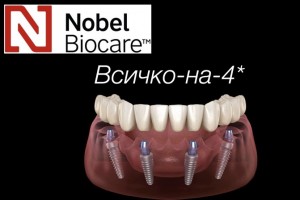
Currently, the All-on-4* concept is the most widely clinically studied methodology for complete rehabilitation with direct loading, thus making it the most extensively verified in time.
I will try to bust some of the myths, about All-on-4*, which may often be found online.
Myth 1: Parts of the prosthetic structure will be overloaded, due to there being only four available supports.
Long-term studies, lasting for more than 25 years, conducted by various authors, including the person, who originally developed the system (P. Malo), have proven that four implants, installed in accordance with the surgical protocol are fully capable of support a prosthetic structure of 12 units. The inclination of the two posterior implants, makeс it possible to increase the area of the actual bonе-implant contact. This creates optimal conditions for supporting the structure, even with minimal volume of the bone. Furthermore, the metal core of the structure unites the four implants and will ensure equal distribution of the chewing load.
Myth 2: Due to the small number of implants, the load is unequally distributed on the bone and may cause bone loss.
This is not true. As already noted, implants are installed at a 45* angle and in fact the entire area of the bone, underneath the nose and between the sinuses takes the chewing load. This often leads to the question: And what if this installation angle is further increased? Such a scenario is extremely undesirable, since it may compromise the entire concept. In these cases, solutions with building bone and installing 6 implants is preferred.
Myth 3: If the available bone is insufficient, implants may remain not fully covered by bone.
There are surgical templates, ensuring absolutely precise placement of the implants. This is based on a pre-defined treatment plan, developed on 3D models of the jaws. Thus, the development of digital technologies help surgeons and ensure the maximum precision and safety of the implant installation.
D-r Petar Duchev

